
Across Africa, promising approaches to antimicrobial resistance are being developed, tested and implemented. The harder question often comes next: how do we ensure that what works survives beyond a project cycle?
This question featured prominently at the 16th ECSA-HC Best Practices Forum and 32nd Directors Joint Consultative Committee Meeting, held from 5–7 August 2026 in Manzini, Eswatini.
The Forum brought together ministerial delegates, policymakers, researchers, academics, civil society, regional organisations and Regional Economic Communities to exchange evidence and approaches for strengthening health systems across the region.
ReAct Africa, represented by Yamanya Tembo and Mkuzho Mwaya, convened a parallel session with ECSA-HC and Africa CDC to bring antimicrobial resistance into that wider conversation.
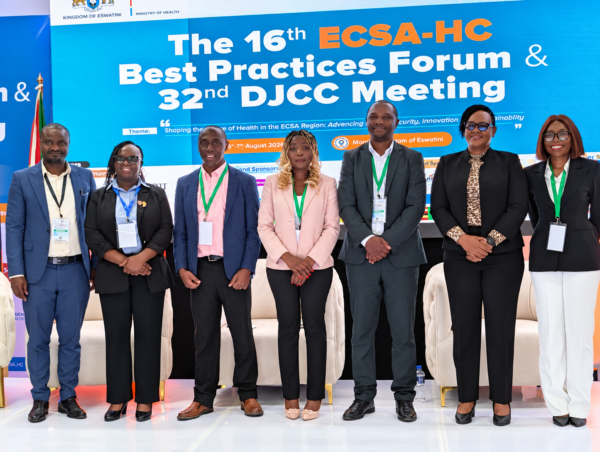
The session introduced participants to the newly launched Continental AMR Framework and showcased examples of AMR best practices from across Africa. It also provided an opportunity to take forward lessons emerging from the ReAct Africa pre-conference Knowledge Exchange meeting and the ReAct Africa Annual Antimicrobial Resistance Conference 2026.
One message stood out: successful AMR interventions need a pathway to institutionalisation.
Rather than remaining dependent on individual projects, effective approaches need to become part of routine programmes, institutional mandates, financing arrangements and accountability mechanisms.
Evidence needs a route into policy
Institutionalisation also depends on how effectively evidence reaches decision-makers.
ReAct Africa highlighted the need to generate locally relevant evidence while engaging policymakers and implementers early enough for that evidence to respond to actual decision-making needs.
Research findings then need to be translated into forms that can inform policy, programme design and financing decisions. Follow-up should also be embedded within existing national coordination mechanisms rather than creating parallel structures.
The discussion echoed a central message emerging from RAAC26: Africa already has promising AMR interventions and locally generated solutions. The next challenge is ensuring that effective approaches are financed, embedded within systems, measured and sustained.
More from "Policy Engagement"
- Zambia- Parliamentarian Engagement
- Parliamentarians Rally to Tackle Antimicrobial Resistance in Africa
- Strengthening Parliamentary Support for the Fight Against AMR
- Regional Leaders Align Ahead of Global AMR Ministerial Meeting
- Zambia Strengthens Political Leadership on Antimicrobial Resistance Through Parliamentarians’ Caucus
- Zambia Has AMR Evidence. The Next Challenge Is Getting It into Policy.
- When an AMR Intervention Works, How Do We Make It Last?