
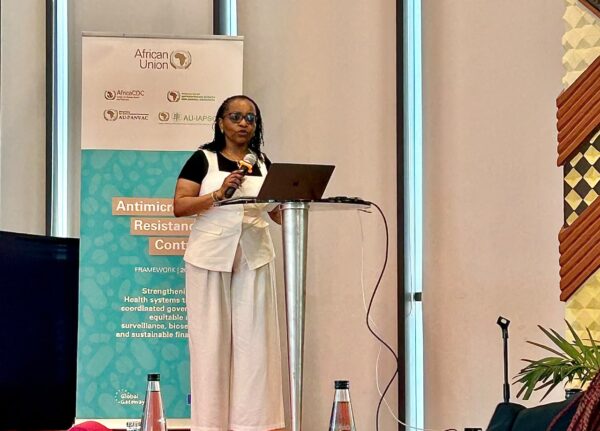
Stakeholders convened at the continental meeting to co-create actionable strategies for the Implementation Roadmap and Continental Accountability Mechanisms for the AU Framework for AMR Control (2026–2030) in Mombasa, Kenya. The meeting was hosted by the Africa Centres for Disease Control and Prevention (Africa CDC) and the African Union Inter-African Bureau for Animal Resources (AU-IBAR) in partnership with other AU technical bodies including Inter-African Phytosanitary Council (AU-IAPSC) and African Union Pan-African Veterinary Vaccine Centre (AU-PANVAC) amongst others.
ReAct Africa participated in the meeting through Dr Tracie Muraya, Deputy Director for Policy and Strategy, contributing particularly to the advocacy workstream under the Framework’s Strategic Goal 5 on AMR education, advocacy and awareness. One of the important themes emerging from the discussions was the role advocacy can play across the AMR response.
Rather than treating advocacy primarily as public awareness, discussions positioned it as a cross-cutting mechanism capable of supporting behaviour change, policy uptake, community ownership and sustainability – both financing and implementation.
That requires different approaches for different audiences. Messages need to be culturally appropriate and grounded in evidence, while AMR advocates need the knowledge and capacity to engage effectively with both communities and decision-makers.
It also means connecting advocacy at different levels, from conversations taking place within communities to engagement with parliamentarians and policymakers who can influence legislation, budgets and national priorities.
Who needs to be part of implementation?
The implementation discussions also highlighted the importance of widening participation in the AMR response. Civil society organisations, young people, media, religious leaders and other trusted community actors can help translate technical AMR priorities into messages and actions that resonate within different contexts.
Their participation, however, needs to be supported. Among the priorities identified were stronger capacity building for advocates and dedicated financing for advocacy, helping ensure engagement can be sustained rather than limited to individual campaigns or awareness periods.
Bringing community experience to continental implementation
ReAct Africa’s participation provided an opportunity to bring lessons from its existing work with civil society, communities, youth and faith-based actors into discussions on implementing the continental framework.
There is also scope to contribute across other areas of the Framework. ReAct Africa’s programme portfolio extends to AMR governance and accountability, antimicrobial stewardship, infection prevention and control, and WASH, creating opportunities to connect experience from implementation with continental priorities.
More from "Youth Engagement"
- AMR Leaders Program
- Maarifa Kids Project
- African Youth AMR Alliance Task Force Launch
- African Youth Position Statement on Antimicrobial Resistance (AMR)
- Policy Brief-Engaging Youth in Antimicrobial Resistance at the Country and Regional Level
- Broadening Efforts in Youth Engagement
- AMR Game Launch
- Engaging Youth Through Country Structures and Institutions
- Zambia National AMR Debates for Tertiary Students
- Growing Africa’s Next Generation of AMR Leaders
- Eden vs Apex: AMR Knowledge Goes Head-to-Head
- Young People Are Talking About AMR and Helping Decide What Happens Next
- New African Union AMR Framework
- More Than a Competition: What Happens When Students Put AMR Up for Debate?