
Here you find guidance, methods and tools to measure occurrence of antibiotic resistance in animal settings.
Data on antibiotic resistance in animal settings can be generated on a small or large scale. Conducting point prevalence surveys is a good way to get started and can be a useful tool to quickly assess the current situation. Over time efforts can be scaled up and eventually act as inputs to national surveillance. Besides scarcity of resources, a main challenge for monitoring resistance in livestock is the harmonization among countries of analytic methods as well as sampling frames.
Which bacteria to monitor?
In the animal sector, three categories of bacteria usually are included in surveillance programs:
- Zoonotic bacteria. These bacteria can develop resistance in the animal reservoir and may also transfer to and cause infections in man.
- Indicator bacteria. These bacteria are isolated from healthy individuals and give a more accurate value of the occurrence of resistance in the entire animal population
- Animal pathogens. Pathogenic isolates from clinical sampling are usually not representative for the true occurrence of resistance, but are important for detecting emerging resistance.
In the EU and USA, surveillance covers zoonotic bacteria (Salmonella spp, Campylobacter jejuni and Campylobacter coli) and indicator bacteria (commensal E. coli, Enterococcus faecalis and Enterococcus faecium) isolated from healthy animals and food.
Pathogenic bacteria from clinical cases are at present included in some national surveillance programs. Many of these samples are likely from animals treated with antibiotics. This has to be taken into account when analyzing such data. However, there is a need for harmonized monitoring of data for certain types of resistance in certain animal pathogens to be able to detect emerging resistance that could lead to severe therapy failure. An example is pleuromutilin resistance in Brachyspira hyodysenteriae, the bacterium that causes swine dysentery.
The burden of antibiotic resistance – swine dysentery
Swine dysentery is a severe enteric disease of pigs caused by the bacterium Brachyspira hyodysenteriae. The disease is found worldwide. Swine dysentery causes impaired growth, and severe forms of the disease have mortality rates reaching 50-90%.
The European Food Safety Authority (EFSA) has identified E. coli and B. hyodysenteriae as among the most relevant antimicrobial resistant bacteria in the EU, with large impacts on animal health and production economy. There is currently no vaccine for the disease and there are only a few available treatment options.
Prevention and eradication prgrams are therefore crucial, and have been succesfully applied in some countries. Eradication from farms has resulted both in higher productivity and decreased use of antibiotics. However, permanent monitoring is required to maintain efforts.
Sampling sites and types
The main part of bacterial samples in animal surveillance systems is derived from healthy animals. Fecal samples at farm level or samples from caecal content taken at the slaughterhouse dominate. Also, as samples are taken from animal-derived food, sampling sites include retail foods. When starting up a surveillance program in the animal sector, sampling retail food for resistance can be a start, progressively expanding the sampling to food producing animals.
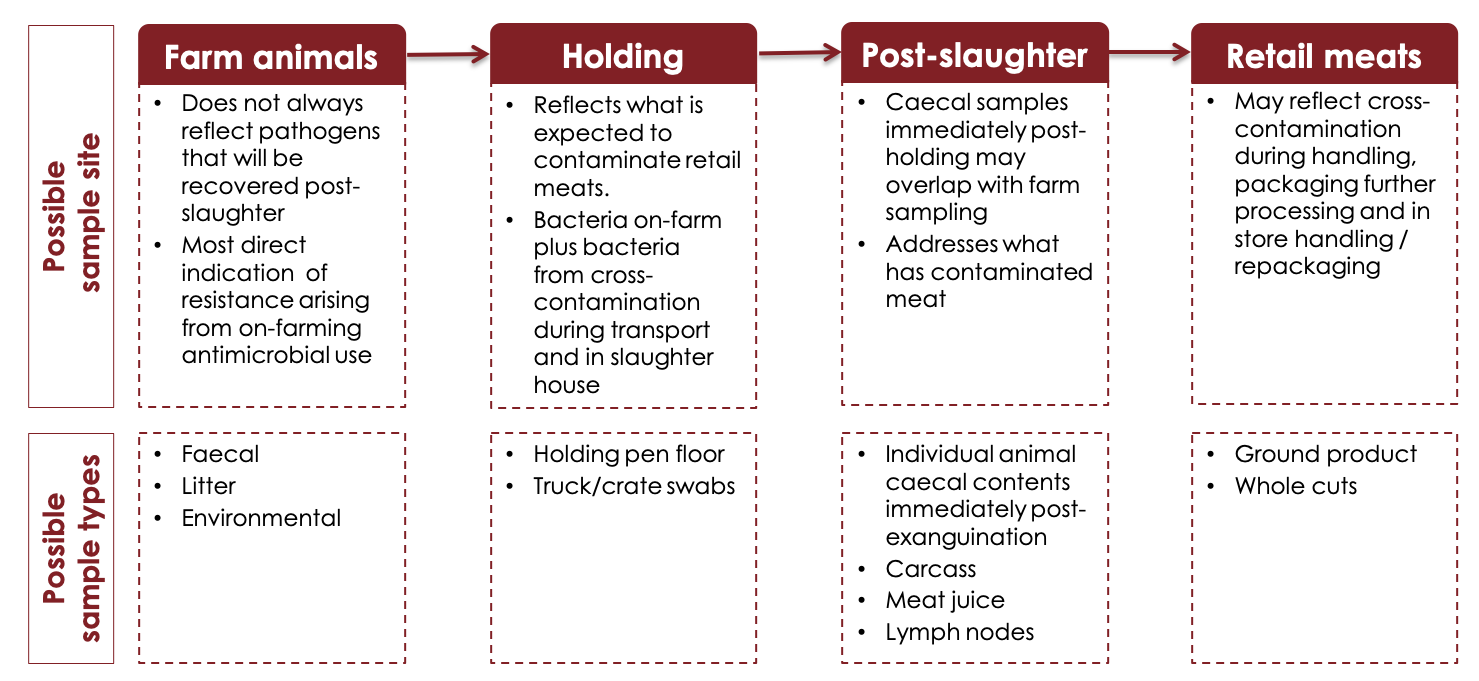
Slaughterhouses are usually the most cost-efficient sampling sites for animal samples, even though the caecal microbiota of the animal may change during transportation and in holding pens at the slaughterhouse. Examples of what to consider when taking bacterial samples throughout the food chain is presented in figure 1.
Sample sites should be connected to a laboratory facility, either on site or if samples can be stored and transported properly, to a central laboratory. The laboratory should at least have the capacity to isolate and identify target bacteria and perform antibacterial susceptibility testing using validated methods according to established standards.
Susceptibility testing of bacteria
The most frequently used tests to determine if bacteria are susceptible or resistant to antibiotics are disc diffusion tests and minimum inhibitory concentration (MIC) tests. The MIC is the lowest concentration of an antibiotic that inhibits the growth of a bacterium. All results should be reported, whether bacteria are susceptible or resistant. The European Committee on Antimicrobial Susceptibility testing (EUCAST) works to define, harmonize and standardize antimicrobial breakpoints and testing methods that are openly available. EUCAST also has a subcommittee dealing with animal pathogens and bacteria with zoonotic potential, VetCAST. CLSI also provides guidance, some resources are freely available through CLSI MICRO FREE.
Please note that it is very important that all products used in susceptibility testing are of good quality. EUCAST issues warnings about known quality issues on their website.
Data management
To be able to contribute to national and international surveillance, retrieved data should be entered into a data management software. WHONET fulfils the demands for surveillance and is available free of charge. It is already used in hospital, public health, veterinary and food laboratories in over 100 countries and is available in over 20 languages. WHONET includes a feature for exporting resistance statistics into the format required for producing local and national reports and for uploading to the WHO Global Antimicrobial Resistance Surveillance System (GLASS) web interface.
One Health resources are found on the Antibiotic resistance page.
Selected Resources
Tools and guidelines
| Resource | Description |
| Manual of Diagnostic Tests and Vaccines for Terrestrial Animals | Manual from WOAH providing guidelines and recommendations for diagnosis and identification of important diseases and causative organisms in terrestrial animals. On this page you can search in the manual. See for example SECTION: 2.1. LABORATORY DIAGNOSTICS, Chapter 2.1.1: Laboratory methodologies for bacterial antimicrobial susceptibility testing, that explains how susceptibility tests should be performed. |
|
Veterinary Committee on Antimicrobial Susceptibility Testing (VetCAST) |
Information portal and guidance of the European Committee on Antimicrobial Susceptibility Testing (EUCAST) subcommittee for antimicrobial susceptibility testing of bacterial pathogens of animal origin and animal bacteria with zoonotic potential. See also the EUCAST page, that provides step-by-step guidance on susceptibility testing to aid clinical decision making, and educational materials on the EUCAST methodology. |
| WHONET Software | Data software for the management and analysis of antibiotic resistance data. Free to download and use, and available in 54 languages. It supports local, national, regional, and global surveillance efforts including in animal health and food laboratories. The software includes CLSI and EUCAST human and animal breakpoints, and epidemiological cutoff values. Also provides an online training center. |
| Resistance bank | Database. Repository of antimicrobial resistance data from individual point prevalence surveys done in animal populations. Links to video tutorial. Provides downloads of country reports based on existing data (please note that the data are aggregated and extrapolated and may be scarce). Focuses on Central and Latin America, Africa and Asia. |
| Biological monitoring | Information portal with data, reports, dashboards on the occurrence of zoonoses, zoonotic agents, antimicrobial resistance, animal populations and food-borne outbreaks in the European Union, and some other European countries. Also presents informative “storymaps” on specific bacteria such as Salmonella, Listeria and Brucella. |
| Foodborne antimicrobial resistance. Compendium of Codex standards | Standards/Guidelines for the responsible use of antimicrobials in food-producing animals. For example describes responsibilities for regulatory authorities, veterinary pharmaceutical industry, wholesalers, retailers, veterinarians and farmers, and gives guidance on assessing the risk to human health from foodborne antibiotic resistant bacteria. Also available in French, Russian and Spanish. |
More from "Antibiotic resistance"
- Humans
- Food animals
- Environment