
2025-01-30
The increasing global crisis of antibiotic resistance demands urgent and multi-faceted solutions, yet a less recognised driver of resistance is pollution from antibiotic production. Waste from manufacturing sites can create hotspots of resistance, disproportionately affecting low- and middle-income countries. This policy brief addresses the intersection of environmental pollution, antibiotic resistance, and equitable access to antibiotics, offering practical recommendations for systemic change.
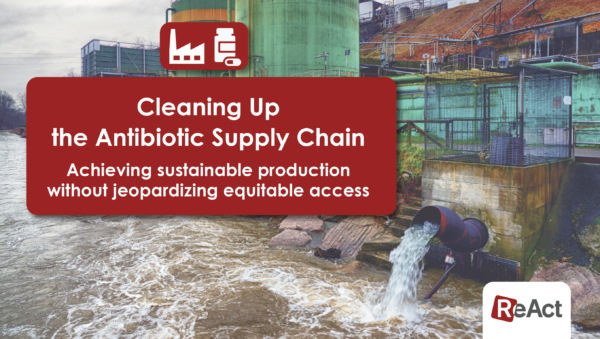 Click image to download the ReAct policy brief (PDF). Photo: Claudio Arnese, Istock.
Current initiatives and gaps
While global initiatives like the WHO’s guidelines on wastewater management and voluntary frameworks by the AMR Industry Alliance represent steps forward, significant gaps persist. Many initiatives lack enforcement, transparency, or scalability, particularly in low- and middle-income countries. The brief underscores the urgent need for harmonised global standards, robust surveillance systems, and funding mechanisms to address these gaps and drive transformative change in antibiotic production practices.
Barriers to sustainable antibiotic production
Lack of Transparency in Manufacturing Processes and Supply Chains
Companies are seldom required to disclose their production practices or environmental impacts, limiting accountability and enabling pollution, particularly in low- and middle-income countries, where many pharmaceutical companies outsource their production.
Weak regulatory frameworks and technology transfer
Many low- and middle-income countries lack robust regulations and enforcement for environmental and pharmaceutical practices. Insufficient technology transfer from high-income countries further hinders manufacturers’ ability to adopt sustainable solutions.
Inefficiencies in global surveillance of antibiotic residues
Global systems to monitor antibiotic residues are fragmented, with no standardized protocols for tracking environmental contamination, especially in low- and middle-income countries, where resources and infrastructure are limited.
Lack of awareness among key stakeholders
Policymakers, healthcare providers, and consumers often lack understanding of how antibiotic pollution drives resistance, leading to insufficient regulatory action and industry accountability.
Key takeaways
Sustainable antibiotic production is essential for mitigating antibiotic resistance while safeguarding environmental and public health. The brief highlights the critical need for transparent supply chains, stronger regulations, and global cooperation. Recommendations include the adoption of an “End-to-End” approach, integration of environmental standards into procurement policies, and incentivizing responsible manufacturing practices. These strategies not only reduce pollution but also promote equitable access to life-saving antibiotics.
More from "2025"
- ReAct 2026: Six focus areas
- Sweden’s new Strategy on Antimicrobial Resistance
- 80 Years since the Nobel Prize for penicillin: Saving lives, facing resistance
- Zambia for WAAW: Maarifa kids book day
- Latin American “Minga” for World AMR Awareness Week
- ReAct Asia Pacific: young voices and artistic expression
- Workshop at Uppsala University: AMR and community engagement
- New Asia-Pacific Youth AMR Task Force!
- 3 questions to ZDOROVI – ReAct’s new partner in Ukraine
- ReAct activities for World AMR Awareness Week 2025
- ReAct highlights World AMR Awareness Week 2025
- Unlocking AMR Financing: Optimizing international resources for an accelerated response to antibiotic resistance
- Impressions from the World Health Summit 2025: Taking responsibility for health in a fragmenting world
- New ReAct AMR podcast in Africa!
- ReAct recommendations to strengthen the Global Action Plan on AMR
- ReAct 20 in Latin America: 3 publications on action on AMR and care for life
- ReAct 20: Two decades of empowering communities: A global call to invest in grassroots AMR Action
- Give evidence real power: What an Independent Panel on AMR can and should do
- ReAct Project: Building resilience against AMR amid conflict in Ukraine
- Shaping the future of AMR evidence-based action: Insights into the IPEA founding document and consultations
- Zambia: Engaging children in AMR through play-based methods
- 1 year after the UNGA High-Level meeting on AMR – Where are we now?
- 10 key takeaways from the Asia Pacific AMR Conference 2025
- Join ReAct 20 years webinar: Research, action, community participation in addressing antibiotic resistance
- Regional workshop in Ecuador: Towards sustainable and healthy agri-food systems
- Join online! Asia-Pacific AMR Conference 2025: From Global Declarations to Regional Action
- Why youth voices matter for stronger action on antibiotic resistance
- National media workshop in Delhi calls for urgent action on AMR
- Join ReAct 20 years webinar! The past, present, and future of community engagement on AMR
- The 8th International Congress of Socio-Environmental Health, Rosario, Argentina
- First quick takeaways from the ReAct Africa and South Centre Annual Conference
- ReAct Report: Two decades of impactful, community-driven action
- Ecuador: Play and art to educate on health and antibiotic resistance
- Reflecting on WHA78: Progress, gaps, and the path forward for antibiotic resistance and global health governance
- ReAct Latin America celebrates 20 years of multi-sectoral action on antibiotic resistance
- ReAct Asia Pacific wins prestigious Trinity Challenge Award for “Campus to Farm” initiative
- Join ReAct Africa and South Centre Conference online!
- Renewed Sida funding boosts ReAct’s global efforts!
- Highlighting the first 1000 days of life on World Health Day
- ReAct Impact Report: How ReAct’s work helped move the needle in 2023-2024
- ReAct reflection on ESCMID Global conference 2025
- The youngest scientists: Teacher Marianela Carrapizo about Alforja for young children
- Accelerating the global AMR response in the context of global health financing crisis
- Empowering the next generation: ReAct Africa and Beleza Talent Agency host community cleanup on World Water Day
- A regional meeting to explore the link between water, food, and antibiotics
- AI-Powered antibiotic stewardship: ReAct Asia Pacific’s consultation
- ReAct 20 years: Launch of new Toolbox page for youth!
- Reflecting on infection, life, ecology on World Water Day
- ReAct Africa launches Youth Innovation Hub to address AMR
- A living laboratory for learning: The school garden as an educational tool
- India: Strengthening partnerships for stronger action on AMR
- ReAct’s Mirfin Mpundu: Heartbreak leads to hope for global AMR advocate
- Healthy eating fair: Learning about food, ecosystem and microbes
- ReAct Africa Youth Impact Report: Mobilizing young people for stronger action on antimicrobial resistance
- ReAct 2025 ambitions: increase political will, strengthen civil society engagement and address barriers to access
- One Health and Climate Change Hub: A bold step towards integrating AMR into the public health agenda
- Experts launch comprehensive plan to address antimicrobial resistance in Latin America
- Children lead the way: ReAct’s novel approach to address antibiotic resistance
- ReAct Policy Brief: Sustainable antibiotic production