
2025-02-21
After losing his mother to a drug-resistant infection, Mirfin Mpundu has dedicated his life to combating antibiotic resistance. Now, as a leading advocate for ReAct, he works tirelessly to support governments, empower young AMR champions, and raise awareness through innovative community engagement. Turning personal heartbreak into purpose, he is driving global efforts to curb the global health challenge of AMR.
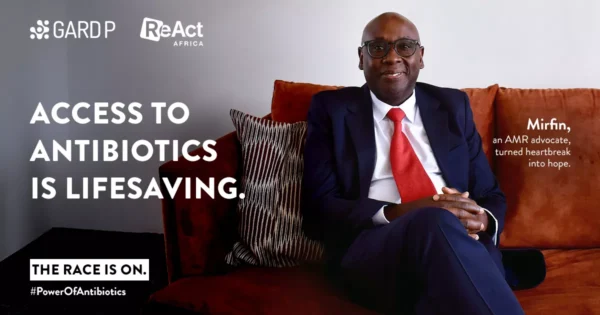
For global AMR advocate, Professor Mirfin Mpundu, the heartbreak of losing his mother to a drug-resistant infection propelled him to dedicate his life to countering antimicrobial resistance, and in turn help save the lives of others.
“My mother went into hospital well and healthy but died a week after giving birth to my sister,”
says Mirfin.
“While recovering from a C-section, she picked up an infection which was resistant to the available antibiotics in the hospital. It rapidly led to sepsis. I’ve always believed that my mother’s death could have been avoided if they’d had the right antibiotics to treat her infection.”
The tragedy became a turning point
The tragedy was a turning point for Mirfin, who was 18 at the time. He decided to study to become a clinical pharmacist. Since his home country of Zambia didn’t have a pharmacy school, he got a scholarship for his undergraduate studies in Tanzania. He later specialized in infectious diseases and public health in the United States before going back to Zambia. Mirfin has since become one of the leading global voices on the importance of accessing effective antibiotics and advocating for ways to prevent antimicrobial resistance.
Proud of growing band of young volunteers
As the co-founder of ReAct Africa, Mirfin and his team have supported many African governments in developing and implementing their national action plans on antimicrobial resistance.
Mirfin is particularly proud of the growing band of young volunteers he has helped to nurture over the years. Through ReAct Africa, young people, mostly students, are taught about AMR and how to bring about change through using antibiotics appropriately, and how to prevent infections. They in turn take the knowledge they’ve learnt deep into the community – from schools and clinics to churches and campuses, often relaying their message through art, poetry and theatre. Students have also formed One Health clubs. The program has cascaded into a range of African countries, such as Kenya, Tanzania and Liberia.
Annual ReAct Africa & South Centre AMR Conference in Zambia
Many of these young “AMR champions”, together with policymakers, healthcare workers and researchers also gather at the annual AMR conferences in Zambia, hosted by ReAct Africa and the South Centre. The conference pulses with excitement and energy as people talk about what they are doing to improve infection prevention and control, prevent misuse of antibiotics and increase access to effective antibiotics.
They also discuss ways to best engage politicians, intergovernmental organizations and the global community to counter AMR in Africa, which is disproportionately affected by AMR.
Put AMR on the African global health agenda
Mirfin has put AMR firmly on the African agenda and onto the global stage. He has become a sought-after speaker in global conferences and working groups and often writes on gaps in access to antibiotics and diagnostics, AMR as a health security issue and other vital issues. He has also supported the World Bank and Africa CDC and other organisations in their work in Africa and Asia.
Full circle of life
For Mirfin, life has turned full circle.
“My mother’s death was devastating. But it inspired me to commit to this field. Antibiotic resistance causes so much illness and death. It drains money from families as people become too ill to work. It also leaves people feeling desperate as they often can’t afford some of the third or fourth generation antibiotics that could work, if they are available at all. People often resign themselves to die,”
says Mirfin.
His mother would have been proud
This is an untenable situation, which needs change, and constant attention, especially in Sub-Saharan Africa, which is particularly hard-hit by drug-resistant infections. While more funding and commitment is needed, Mirfin is not giving up the fight.
“We’ve been strong advocates, not just at a country or regional level, but globally. We have worked with intergovernmental organisations and the Africa CDC on stemming AMR. Our young people – as the doctors, nurses and pharmacists of tomorrow – are playing their part. We have been the voice of the Global South, and we want to get even stronger.”
Mirfin’s mother would have been proud. He has honored her memory through his dedication towards a better outcome for this generation and those to come.
Read a few interviews by ReAct
Sweden: Pernilla’s 8-day old daughter died from sepsis – caused by resistant bacteria Klebsiella.
Vanessa Carter: 3 years of surviving a drug-resistant infection made me want to create change.
When Doctor Rianto suffered from antibiotic resistance as a patient.
Dr. Honar Cherif: My patients can receive 5-10 courses of antibiotics during their cancer treatment.
Caring about antibiotic resistance is similar with reducing the plastic waste or saving water.
More from "2025"
- ReAct 2026: Six focus areas
- Sweden’s new Strategy on Antimicrobial Resistance
- 80 Years since the Nobel Prize for penicillin: Saving lives, facing resistance
- Zambia for WAAW: Maarifa kids book day
- Latin American “Minga” for World AMR Awareness Week
- ReAct Asia Pacific: young voices and artistic expression
- Workshop at Uppsala University: AMR and community engagement
- New Asia-Pacific Youth AMR Task Force!
- 3 questions to ZDOROVI – ReAct’s new partner in Ukraine
- ReAct activities for World AMR Awareness Week 2025
- ReAct highlights World AMR Awareness Week 2025
- Unlocking AMR Financing: Optimizing international resources for an accelerated response to antibiotic resistance
- Impressions from the World Health Summit 2025: Taking responsibility for health in a fragmenting world
- New ReAct AMR podcast in Africa!
- ReAct recommendations to strengthen the Global Action Plan on AMR
- ReAct 20 in Latin America: 3 publications on action on AMR and care for life
- ReAct 20: Two decades of empowering communities: A global call to invest in grassroots AMR Action
- Give evidence real power: What an Independent Panel on AMR can and should do
- ReAct Project: Building resilience against AMR amid conflict in Ukraine
- Shaping the future of AMR evidence-based action: Insights into the IPEA founding document and consultations
- Zambia: Engaging children in AMR through play-based methods
- 1 year after the UNGA High-Level meeting on AMR – Where are we now?
- 10 key takeaways from the Asia Pacific AMR Conference 2025
- Join ReAct 20 years webinar: Research, action, community participation in addressing antibiotic resistance
- Regional workshop in Ecuador: Towards sustainable and healthy agri-food systems
- Join online! Asia-Pacific AMR Conference 2025: From Global Declarations to Regional Action
- Why youth voices matter for stronger action on antibiotic resistance
- National media workshop in Delhi calls for urgent action on AMR
- Join ReAct 20 years webinar! The past, present, and future of community engagement on AMR
- The 8th International Congress of Socio-Environmental Health, Rosario, Argentina
- First quick takeaways from the ReAct Africa and South Centre Annual Conference
- ReAct Report: Two decades of impactful, community-driven action
- Ecuador: Play and art to educate on health and antibiotic resistance
- Reflecting on WHA78: Progress, gaps, and the path forward for antibiotic resistance and global health governance
- ReAct Latin America celebrates 20 years of multi-sectoral action on antibiotic resistance
- ReAct Asia Pacific wins prestigious Trinity Challenge Award for “Campus to Farm” initiative
- Join ReAct Africa and South Centre Conference online!
- Renewed Sida funding boosts ReAct’s global efforts!
- Highlighting the first 1000 days of life on World Health Day
- ReAct Impact Report: How ReAct’s work helped move the needle in 2023-2024
- ReAct reflection on ESCMID Global conference 2025
- The youngest scientists: Teacher Marianela Carrapizo about Alforja for young children
- Accelerating the global AMR response in the context of global health financing crisis
- Empowering the next generation: ReAct Africa and Beleza Talent Agency host community cleanup on World Water Day
- A regional meeting to explore the link between water, food, and antibiotics
- AI-Powered antibiotic stewardship: ReAct Asia Pacific’s consultation
- ReAct 20 years: Launch of new Toolbox page for youth!
- Reflecting on infection, life, ecology on World Water Day
- ReAct Africa launches Youth Innovation Hub to address AMR
- A living laboratory for learning: The school garden as an educational tool
- India: Strengthening partnerships for stronger action on AMR
- ReAct’s Mirfin Mpundu: Heartbreak leads to hope for global AMR advocate
- Healthy eating fair: Learning about food, ecosystem and microbes
- ReAct Africa Youth Impact Report: Mobilizing young people for stronger action on antimicrobial resistance
- ReAct 2025 ambitions: increase political will, strengthen civil society engagement and address barriers to access
- One Health and Climate Change Hub: A bold step towards integrating AMR into the public health agenda
- Experts launch comprehensive plan to address antimicrobial resistance in Latin America
- Children lead the way: ReAct’s novel approach to address antibiotic resistance
- ReAct Policy Brief: Sustainable antibiotic production