
2025-02-25
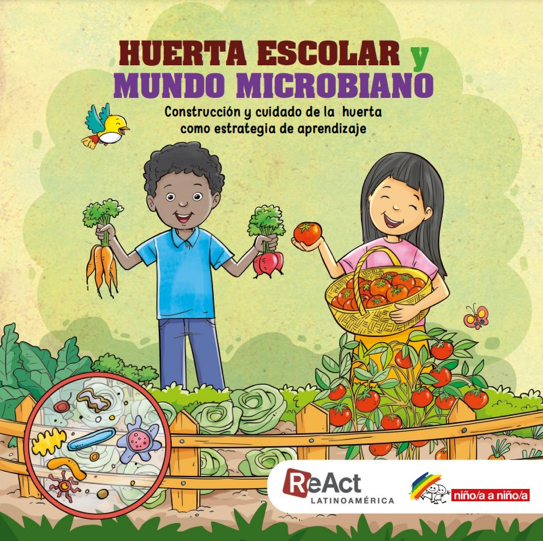
As the world grapples with pressing environmental and health challenges such as antibiotic resistance, innovative approaches to education are more important than ever. To support educators in integrating school gardens into their teaching, ReAct has developed a practical guide titled "Huerta Escolar y Mundo Microbiano" (School Health and the Microbial World) that offers valuable insights into creating and maintaining school gardens as spaces for learning about food cultivation and soil microbiology. Silvina Alessio, ReAct Latin America, who developed the guide, shares her perspective on how school gardens can inspire and educate.
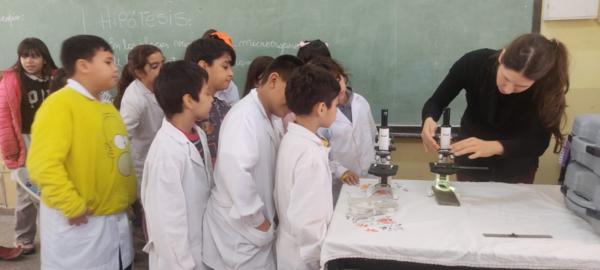
School gardens can serve as living laboratories where students explore sustainability, food systems, and antibiotic resistance through hands-on learning.
This comprehensive resource, authored by Silvina Alessio, ReAct Latin America, transforms the school garden into what she calls “a living laboratory” where children can directly observe cultivation processes and understand the critical role of soil microorganisms in food production. As coordinator of the Alforja Educativa project at ReAct Latin America, this since 2012, Alessio brings her extensive experience in environmental education to this practical guide.
The following interview with Silvina Alessio explores her vision for school gardens and how they can impact children’s learning, health, and connection to nature.
 What is the central message of the guide?
The central message is to understand and value the function of microorganisms in the life of the earth and their role in the production of healthy food. The garden is a living laboratory where children and teachers can interact with nature in a practical way, directly observing cultivation processes and the importance of soil beyond just its physical appearance.
How was this guide developed?
It wasn’t an isolated process. We worked with various educational communities, beginning by exploring children’s prior knowledge about the microbial world and bacteria in the soil. Later, we designed playful activities to help children understand the importance of microorganisms in agricultural production. The impact of the project has transcended borders, expanding to different countries and awakening interest among teachers and communities seeking to implement school gardens as pedagogical tools.
What advice would you give to schools wanting to start a garden but don’t know where to begin?
It’s not necessary to have large tracts of land. You can make gardens in pots, recycled tires, or any available space. The guide offers a detailed chapter on how to start a garden from scratch, including soil preparation, seed selection, and planting strategies appropriate for each season.
How do you think School Gardens impact children’s learning and motivation?
This experience leaves an indelible mark on students, allowing them to connect with the land and understand natural processes that would otherwise go unnoticed. All curricular areas can be integrated into the garden, turning it into a space where different learnings come together in a practical and meaningful way. Beyond knowledge about soil and crops, the garden promotes comprehensive education that strengthens children’s social, emotional, and cooperative skills, as well as values like solidarity, responsibility, and empathy.
How does learning about soil microbiology affect children’s health?
Understanding the relationship between growing food and healthy eating helps children improve their nutrition and reduce unnecessary consumption of medications and antibiotics. When children grasp how soil nutrition influences plant growth and food quality, they develop a more holistic perspective on health that begins with the soil itself.
More from "2025"
- ReAct 2026: Six focus areas
- Sweden’s new Strategy on Antimicrobial Resistance
- 80 Years since the Nobel Prize for penicillin: Saving lives, facing resistance
- Zambia for WAAW: Maarifa kids book day
- Latin American “Minga” for World AMR Awareness Week
- ReAct Asia Pacific: young voices and artistic expression
- Workshop at Uppsala University: AMR and community engagement
- New Asia-Pacific Youth AMR Task Force!
- 3 questions to ZDOROVI – ReAct’s new partner in Ukraine
- ReAct activities for World AMR Awareness Week 2025
- ReAct highlights World AMR Awareness Week 2025
- Unlocking AMR Financing: Optimizing international resources for an accelerated response to antibiotic resistance
- Impressions from the World Health Summit 2025: Taking responsibility for health in a fragmenting world
- New ReAct AMR podcast in Africa!
- ReAct recommendations to strengthen the Global Action Plan on AMR
- ReAct 20 in Latin America: 3 publications on action on AMR and care for life
- ReAct 20: Two decades of empowering communities: A global call to invest in grassroots AMR Action
- Give evidence real power: What an Independent Panel on AMR can and should do
- ReAct Project: Building resilience against AMR amid conflict in Ukraine
- Shaping the future of AMR evidence-based action: Insights into the IPEA founding document and consultations
- Zambia: Engaging children in AMR through play-based methods
- 1 year after the UNGA High-Level meeting on AMR – Where are we now?
- 10 key takeaways from the Asia Pacific AMR Conference 2025
- Join ReAct 20 years webinar: Research, action, community participation in addressing antibiotic resistance
- Regional workshop in Ecuador: Towards sustainable and healthy agri-food systems
- Join online! Asia-Pacific AMR Conference 2025: From Global Declarations to Regional Action
- Why youth voices matter for stronger action on antibiotic resistance
- National media workshop in Delhi calls for urgent action on AMR
- Join ReAct 20 years webinar! The past, present, and future of community engagement on AMR
- The 8th International Congress of Socio-Environmental Health, Rosario, Argentina
- First quick takeaways from the ReAct Africa and South Centre Annual Conference
- ReAct Report: Two decades of impactful, community-driven action
- Ecuador: Play and art to educate on health and antibiotic resistance
- Reflecting on WHA78: Progress, gaps, and the path forward for antibiotic resistance and global health governance
- ReAct Latin America celebrates 20 years of multi-sectoral action on antibiotic resistance
- ReAct Asia Pacific wins prestigious Trinity Challenge Award for “Campus to Farm” initiative
- Join ReAct Africa and South Centre Conference online!
- Renewed Sida funding boosts ReAct’s global efforts!
- Highlighting the first 1000 days of life on World Health Day
- ReAct Impact Report: How ReAct’s work helped move the needle in 2023-2024
- ReAct reflection on ESCMID Global conference 2025
- The youngest scientists: Teacher Marianela Carrapizo about Alforja for young children
- Accelerating the global AMR response in the context of global health financing crisis
- Empowering the next generation: ReAct Africa and Beleza Talent Agency host community cleanup on World Water Day
- A regional meeting to explore the link between water, food, and antibiotics
- AI-Powered antibiotic stewardship: ReAct Asia Pacific’s consultation
- ReAct 20 years: Launch of new Toolbox page for youth!
- Reflecting on infection, life, ecology on World Water Day
- ReAct Africa launches Youth Innovation Hub to address AMR
- A living laboratory for learning: The school garden as an educational tool
- India: Strengthening partnerships for stronger action on AMR
- ReAct’s Mirfin Mpundu: Heartbreak leads to hope for global AMR advocate
- Healthy eating fair: Learning about food, ecosystem and microbes
- ReAct Africa Youth Impact Report: Mobilizing young people for stronger action on antimicrobial resistance
- ReAct 2025 ambitions: increase political will, strengthen civil society engagement and address barriers to access
- One Health and Climate Change Hub: A bold step towards integrating AMR into the public health agenda
- Experts launch comprehensive plan to address antimicrobial resistance in Latin America
- Children lead the way: ReAct’s novel approach to address antibiotic resistance
- ReAct Policy Brief: Sustainable antibiotic production