
2025-01-30
Tamil Nadu’s new One Health and Climate Change Hub aims to tackle antimicrobial resistance (AMR) by integrating strategies across health, agriculture, environment, and more. Launched in November 2024, it emphasizes cross-sector collaboration, political commitment, and actionable solutions.
The initiative seeks to strengthen AMR’s role in public health and climate resilience efforts, with a focus on coordinated governance, data-driven policies, and public-private partnerships.
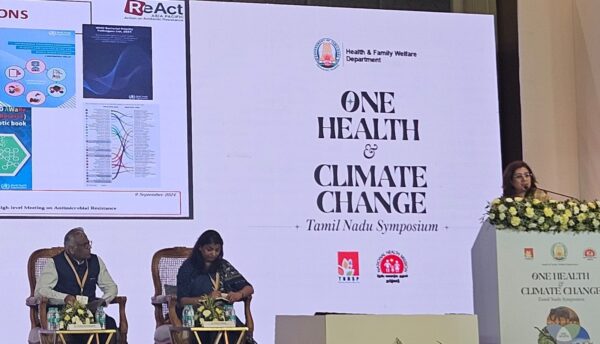
As antimicrobial resistance (AMR) continues to threaten global health and development, integrating AMR mitigation into broader public health and environmental frameworks is no longer an option – it is a necessity. The recent launch of Tamil Nadu’s One Health and Climate Change Hub marks an important step in this direction. It underscores the need for high-level political commitment and stronger cross-sector collaboration to tackle AMR effectively.
A new initiative, a critical opportunity
Recognizing that AMR is not just a health sector issue but a complex challenge requiring a whole-of-government approach,the Government of Tamil Nadu has taken a pioneering step. This is reflected in the establishment of the One Health and Climate Change Hub. Launched in November 2024 through a government order, this initiative brings together key ministries, including:
- Health
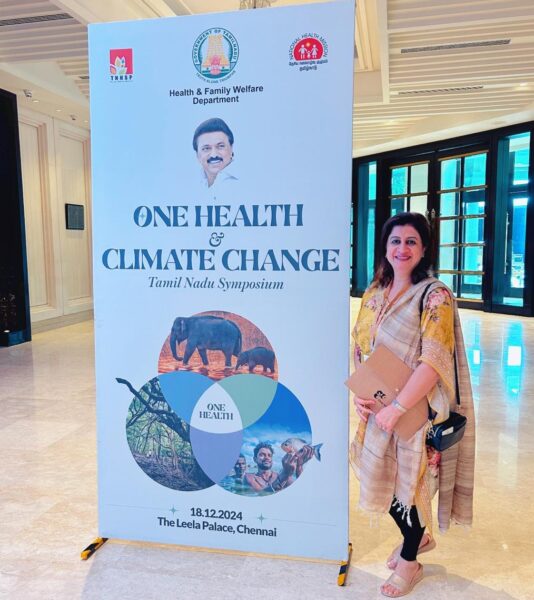
Dr Geethanjali Kapoor, attends The One Health and Climate Change Hub workshop. Photo: Private - Agriculture
- Animal Husbandry
- Environment
- Public Works
The aim is to develop integrated strategies that address AMR as part of broader public health and climate resilience efforts. This initiative was inaugurated with a high-level workshop in Chennai, convening:
- policymakers
- scientists
- public health professionals
- and environmental experts
Their goal was to explore how AMR can be prioritized within multi-sectoral frameworks. The active participation of ministers from different departments signaled a commitment to breaking silos and fostering collaborative solutions.
Why AMR must be a central public health priority
AMR poses an existential challenge to modern medicine, yet its mitigation efforts often remain fragmented. Without systematic integration into national and regional public health strategies, AMR will continue to escalate. This will lead to the undermining of health systems, food security, and environmental sustainability. The Tamil Nadu government’s initiative offers a crucial platform to address this gap, but stronger and sustained efforts will be essential to ensure its impact.
To truly prioritize AMR within the public health agenda, we need to:
• Embed AMR into broader health system strengthening efforts, ensuring its inclusion in national policies and public health initiatives.
• Align AMR strategies with environmental and climate change policies to address the growing evidence linking AMR to pollution, waste mismanagement, and climate-driven disease patterns.
• Strengthen multi-sectoral coordination mechanisms, ensuring that ministries and agencies
The path forward: From commitment to action
While the launch of the One Health and Climate Change Hub represents a promising beginning, the real challenge lies in ensuring its objectives are translated into tangible action. We need to move beyond rhetoric and commit to stronger implementation mechanisms, backed by adequate funding and political will.
To make a lasting impact, Tamil Nadu—and other regions looking to follow this model—must:
• Establish a coordinated governance mechanism to ensure AMR remains a cross-sectoral priority.
• Implement data-driven policies, leveraging surveillance systems and AI-driven early warning systems to track AMR trends.
• Foster public-private partnerships to drive research, innovation, and capacity-building for AMR mitigation.
• Strengthen community engagement and awareness campaigns to promote responsible antimicrobial use and hygiene practices.
A call for stronger leadership and scalable models
Tamil Nadu’s initiative demonstrates the power of political commitment in advancing AMR as a critical public health issue. However, the success of this model will depend on continued leadership, stronger enforcement of regulations, and a clear roadmap for integration into state and national health strategies.
We need bolder actions, stronger policies, and sustained investment to ensure AMR mitigation is not sidelined but embedded into all aspects of public health and environmental governance. The One Health and Climate Change Hub must be more than an initiative—it should serve as a transformative model for other states and nations to follow.
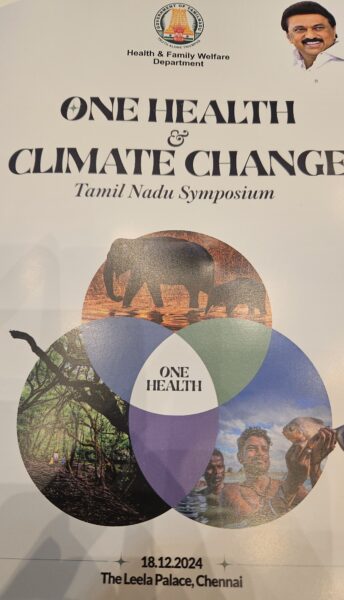
“Resistant pathogens are not confined to humans and animals but are widespread across various environmental components. To effectively address this complex challenge, it is imperative to integrate research findings from all domains and establish a comprehensive One Health-based surveillance system to effectively monitor and mitigate antimicrobial resistance”
– Dr Geetanjali Kapoor, Senior Policy Advisor, ReAct Asia Pacific highlighted during the launch event in December 2024
More from "2025"
- ReAct 2026: Six focus areas
- Sweden’s new Strategy on Antimicrobial Resistance
- 80 Years since the Nobel Prize for penicillin: Saving lives, facing resistance
- Zambia for WAAW: Maarifa kids book day
- Latin American “Minga” for World AMR Awareness Week
- ReAct Asia Pacific: young voices and artistic expression
- Workshop at Uppsala University: AMR and community engagement
- New Asia-Pacific Youth AMR Task Force!
- 3 questions to ZDOROVI – ReAct’s new partner in Ukraine
- ReAct activities for World AMR Awareness Week 2025
- ReAct highlights World AMR Awareness Week 2025
- Unlocking AMR Financing: Optimizing international resources for an accelerated response to antibiotic resistance
- Impressions from the World Health Summit 2025: Taking responsibility for health in a fragmenting world
- New ReAct AMR podcast in Africa!
- ReAct recommendations to strengthen the Global Action Plan on AMR
- ReAct 20 in Latin America: 3 publications on action on AMR and care for life
- ReAct 20: Two decades of empowering communities: A global call to invest in grassroots AMR Action
- Give evidence real power: What an Independent Panel on AMR can and should do
- ReAct Project: Building resilience against AMR amid conflict in Ukraine
- Shaping the future of AMR evidence-based action: Insights into the IPEA founding document and consultations
- Zambia: Engaging children in AMR through play-based methods
- 1 year after the UNGA High-Level meeting on AMR – Where are we now?
- 10 key takeaways from the Asia Pacific AMR Conference 2025
- Join ReAct 20 years webinar: Research, action, community participation in addressing antibiotic resistance
- Regional workshop in Ecuador: Towards sustainable and healthy agri-food systems
- Join online! Asia-Pacific AMR Conference 2025: From Global Declarations to Regional Action
- Why youth voices matter for stronger action on antibiotic resistance
- National media workshop in Delhi calls for urgent action on AMR
- Join ReAct 20 years webinar! The past, present, and future of community engagement on AMR
- The 8th International Congress of Socio-Environmental Health, Rosario, Argentina
- First quick takeaways from the ReAct Africa and South Centre Annual Conference
- ReAct Report: Two decades of impactful, community-driven action
- Ecuador: Play and art to educate on health and antibiotic resistance
- Reflecting on WHA78: Progress, gaps, and the path forward for antibiotic resistance and global health governance
- ReAct Latin America celebrates 20 years of multi-sectoral action on antibiotic resistance
- ReAct Asia Pacific wins prestigious Trinity Challenge Award for “Campus to Farm” initiative
- Join ReAct Africa and South Centre Conference online!
- Renewed Sida funding boosts ReAct’s global efforts!
- Highlighting the first 1000 days of life on World Health Day
- ReAct Impact Report: How ReAct’s work helped move the needle in 2023-2024
- ReAct reflection on ESCMID Global conference 2025
- The youngest scientists: Teacher Marianela Carrapizo about Alforja for young children
- Accelerating the global AMR response in the context of global health financing crisis
- Empowering the next generation: ReAct Africa and Beleza Talent Agency host community cleanup on World Water Day
- A regional meeting to explore the link between water, food, and antibiotics
- AI-Powered antibiotic stewardship: ReAct Asia Pacific’s consultation
- ReAct 20 years: Launch of new Toolbox page for youth!
- Reflecting on infection, life, ecology on World Water Day
- ReAct Africa launches Youth Innovation Hub to address AMR
- A living laboratory for learning: The school garden as an educational tool
- India: Strengthening partnerships for stronger action on AMR
- ReAct’s Mirfin Mpundu: Heartbreak leads to hope for global AMR advocate
- Healthy eating fair: Learning about food, ecosystem and microbes
- ReAct Africa Youth Impact Report: Mobilizing young people for stronger action on antimicrobial resistance
- ReAct 2025 ambitions: increase political will, strengthen civil society engagement and address barriers to access
- One Health and Climate Change Hub: A bold step towards integrating AMR into the public health agenda
- Experts launch comprehensive plan to address antimicrobial resistance in Latin America
- Children lead the way: ReAct’s novel approach to address antibiotic resistance
- ReAct Policy Brief: Sustainable antibiotic production