
2025-02-25
The United States of America School in Ricaurte, Cuenca, was filled with joy and learning during the Healthy Eating Fair, an event that brought the community together to celebrate the importance of healthy and conscious eating. The fair, organized by the Niño a Niño Foundation with the support of the Cantonal Health Council and ReAct Latin America, stood out for its emotional impact in the field of school health. It also provided an opportunity to learn and reflect. The importance of healthy eating, along with the crucial role of bacteria and other microorganisms in our food system, was highlighted."
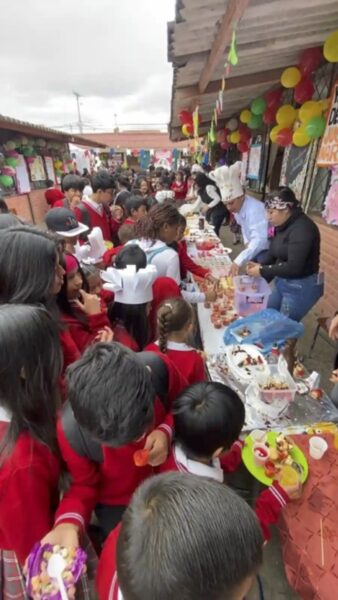
Like a bustling market, the school’s playgrounds were filled with students and a variety of colorful foods. Fathers and mothers actively participated by preparing various healthy and ancestral dishes. Mote pata, mote sucio (corn cooked with pork rinds), various potato dishes, tubers such as sweet potato and cassava, sweets made from local and seasonal fruits, dairy products, and cereals gave color and life to the educational establishment. The fair became a space for learning and reflection, where the importance of healthy eating and the crucial role played by bacteria and other microorganisms in our food system were highlighted.
Food for stomach and thought
These dishes not only delighted the attendees’ palates but also highlighted the rich cultural and nutritional heritage of Ecuador, promoting healthy and sustainable food while fostering a sense of community and belonging.
“This fair is to motivate students, teachers, and parents to eat well and lead a healthy life,”
said Ronny Puma, a tenth-grade student.
“This helps us to have a better quality of life, to be healthy, both physically and mentally,”
concluded Joel Lozada, a student in the same year.
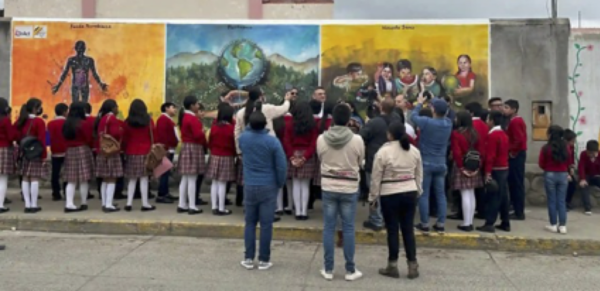
One of the highlights of the event was the unveiling of an impressive mural about the microbial world and the crucial role of bacteria in food. This colorful and lively mural, created by seventh-grade children under the direction of artist Fernando Carrillo, not only beautifies the school but also serves as a visual reminder of the importance of microorganisms in our daily lives, in food production, and in the sustainability of the web of life.
Role of music and art
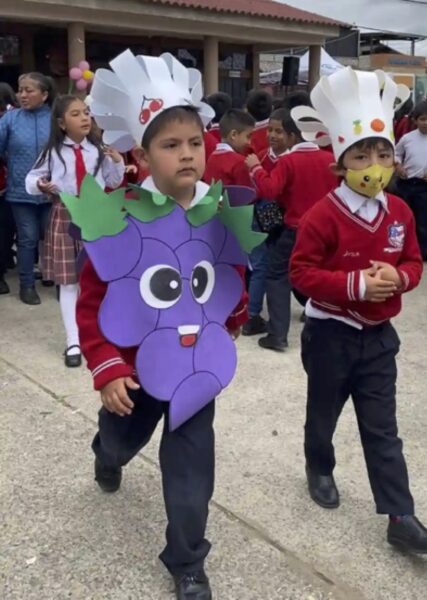
Music and art played central roles in the fair, providing a vibrant soundtrack and captivating visuals that complemented the dining experience. Local artists and students showcased their talents through musical performances and artistic presentations, creating a festive and enriching atmosphere. Traditional melodies and cultural dances added a special touch to the event, highlighting the region’s cultural richness and its close relationship with nature and food.
“We have worked together as an entire educational community—students, teachers, and parents—to teach through food the importance of caring for Mother Earth. Water, food, and the microbial world go beyond what is included in educational curricula,”
emphasized Lorena Ochoa from the Niño a Niño Foundation, coordinator of this project through the Educational Alforja program.
“Today we celebrate not only food but culture, health, and community. This event is proof of what we can achieve when we work together for a healthier and more sustainable future for ourselves and the planet,”
said Dr. Arturo Quizhpe, Director of ReAct Latin America.
The fair became a space for learning and reflection, where the importance of healthy eating and the crucial role played by bacteria and other microorganisms in our food system were highlighted.
For three months, ReAct Latin America, the Child to Child Foundation and the United States of North America School in Ricaurte parish, Cuenca, Ecuador worked together on healthy eating, the microbial world, Pachayacu, and ecosystem care. This program addresses the bacterial world. Through this project all involved have learned so much about the function and roles of bacteria in the world, and that’s what has been transmitted to the children too.
Learn more in the video above.
More from "2025"
- ReAct 2026: Six focus areas
- Sweden’s new Strategy on Antimicrobial Resistance
- 80 Years since the Nobel Prize for penicillin: Saving lives, facing resistance
- Zambia for WAAW: Maarifa kids book day
- Latin American “Minga” for World AMR Awareness Week
- ReAct Asia Pacific: young voices and artistic expression
- Workshop at Uppsala University: AMR and community engagement
- New Asia-Pacific Youth AMR Task Force!
- 3 questions to ZDOROVI – ReAct’s new partner in Ukraine
- ReAct activities for World AMR Awareness Week 2025
- ReAct highlights World AMR Awareness Week 2025
- Unlocking AMR Financing: Optimizing international resources for an accelerated response to antibiotic resistance
- Impressions from the World Health Summit 2025: Taking responsibility for health in a fragmenting world
- New ReAct AMR podcast in Africa!
- ReAct recommendations to strengthen the Global Action Plan on AMR
- ReAct 20 in Latin America: 3 publications on action on AMR and care for life
- ReAct 20: Two decades of empowering communities: A global call to invest in grassroots AMR Action
- Give evidence real power: What an Independent Panel on AMR can and should do
- ReAct Project: Building resilience against AMR amid conflict in Ukraine
- Shaping the future of AMR evidence-based action: Insights into the IPEA founding document and consultations
- Zambia: Engaging children in AMR through play-based methods
- 1 year after the UNGA High-Level meeting on AMR – Where are we now?
- 10 key takeaways from the Asia Pacific AMR Conference 2025
- Join ReAct 20 years webinar: Research, action, community participation in addressing antibiotic resistance
- Regional workshop in Ecuador: Towards sustainable and healthy agri-food systems
- Join online! Asia-Pacific AMR Conference 2025: From Global Declarations to Regional Action
- Why youth voices matter for stronger action on antibiotic resistance
- National media workshop in Delhi calls for urgent action on AMR
- Join ReAct 20 years webinar! The past, present, and future of community engagement on AMR
- The 8th International Congress of Socio-Environmental Health, Rosario, Argentina
- First quick takeaways from the ReAct Africa and South Centre Annual Conference
- ReAct Report: Two decades of impactful, community-driven action
- Ecuador: Play and art to educate on health and antibiotic resistance
- Reflecting on WHA78: Progress, gaps, and the path forward for antibiotic resistance and global health governance
- ReAct Latin America celebrates 20 years of multi-sectoral action on antibiotic resistance
- ReAct Asia Pacific wins prestigious Trinity Challenge Award for “Campus to Farm” initiative
- Join ReAct Africa and South Centre Conference online!
- Renewed Sida funding boosts ReAct’s global efforts!
- Highlighting the first 1000 days of life on World Health Day
- ReAct Impact Report: How ReAct’s work helped move the needle in 2023-2024
- ReAct reflection on ESCMID Global conference 2025
- The youngest scientists: Teacher Marianela Carrapizo about Alforja for young children
- Accelerating the global AMR response in the context of global health financing crisis
- Empowering the next generation: ReAct Africa and Beleza Talent Agency host community cleanup on World Water Day
- A regional meeting to explore the link between water, food, and antibiotics
- AI-Powered antibiotic stewardship: ReAct Asia Pacific’s consultation
- ReAct 20 years: Launch of new Toolbox page for youth!
- Reflecting on infection, life, ecology on World Water Day
- ReAct Africa launches Youth Innovation Hub to address AMR
- A living laboratory for learning: The school garden as an educational tool
- India: Strengthening partnerships for stronger action on AMR
- ReAct’s Mirfin Mpundu: Heartbreak leads to hope for global AMR advocate
- Healthy eating fair: Learning about food, ecosystem and microbes
- ReAct Africa Youth Impact Report: Mobilizing young people for stronger action on antimicrobial resistance
- ReAct 2025 ambitions: increase political will, strengthen civil society engagement and address barriers to access
- One Health and Climate Change Hub: A bold step towards integrating AMR into the public health agenda
- Experts launch comprehensive plan to address antimicrobial resistance in Latin America
- Children lead the way: ReAct’s novel approach to address antibiotic resistance
- ReAct Policy Brief: Sustainable antibiotic production