
2026-09-24
Children are often viewed as the beneficiaries of public health interventions, with adults making decisions on their behalf. Yet, children are key stakeholders in their own right, capable of understanding health challenges, contributing solutions and influencing behaviours within their families, schools and communities.
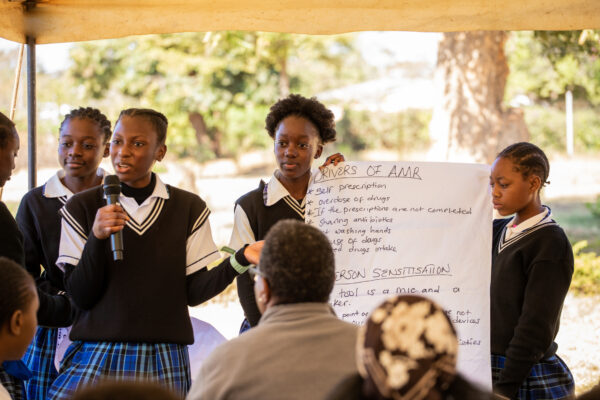
Through Maarifa Kids Zambia, ReAct Africa is working to strengthen the meaningful participation of children in addressing antimicrobial resistance (AMR), recognising that their voices, experiences and ideas are essential to building healthier communities.
In June 2026, ReAct Africa, in partnership with Global Shapers Lusaka Hub, engaged 542 students from Munali Boys and Munali Girls Secondary Schools in Lusaka. The interactive sessions introduced students to AMR, explored its drivers and encouraged them to develop innovative solutions to address the challenge.
Understanding what children already know
Baseline knowledge assessments conducted before the sessions provided insights into children’s understanding of antibiotics, AMR and infection prevention.
521 school children responded
Among 289 boys assessed:
- The average knowledge score was 79.7%.
- While 94.5% correctly recognised that AMR can make infections harder to treat, only 56.7% understood that antibiotics should not be shared with friends or family.
Similarly, 232 girls completed the baseline assessment:
- Recording an average knowledge score of 78.79%.
- 74.14% identified schools as a source of health information, while 64.66% identified parents or guardians.
Although overall awareness was relatively high, the findings revealed specific knowledge gaps requiring targeted education.
The assessments also highlighted the importance of children’s immediate social environments.
These findings demonstrate the importance of engaging children within the networks through which health information is shared.
From learners to agents of change
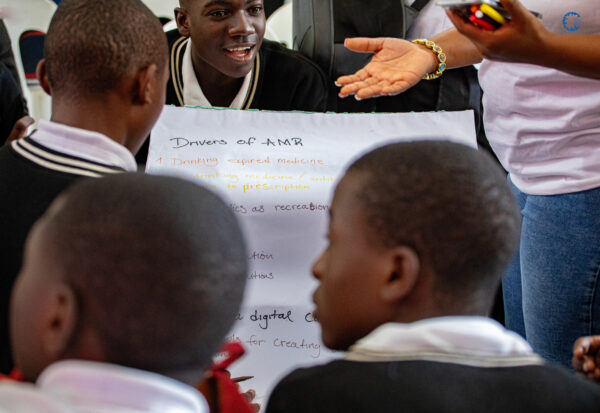
Beyond receiving information, students actively identified AMR drivers and proposed solutions, including medicine reminder applications, AI-powered assistants, podcasts and social media campaigns.
Their ideas demonstrate that children have the capacity to contribute meaningfully to public health discussions when given the opportunity.
A child who understands responsible antibiotic use can share that knowledge with friends, question inappropriate practices at home and encourage healthier behaviours among peers.
More from "2026"
- Maarifa Kids Zambia: Children as key AMR stakeholders
- ReAct Europe at Ukraine ReHealth 2026: Building resilient healthcare in times of war
- From people to leaders: strengthening community voices in the AMR response
- A detective story: Who Killed the Rational Use of Medicine?
- From People to Leaders: Bridging community priorities and global action ahead of Abuja 2026
- Six key takeaways from ReAct Africa Annual AMR Conference 2026
- Beyond diplomatic aspirations: Bridging the implementation gap in Pandemic Preparedness and AMR
- ReAct Asia Pacific Regional AMR Conference 2026 in November!
- Ukrainian Chief Nurse Alla Kuzhel: “Antibiotic resistance is not a problem of the future”
- Launch of book on “Reimagining Resistance: A Journey in Creative Disruption”
- Closing the gap: Highlights from the ReAct side event at the 79th WHA on AMR governance and financing
- New IPC and antibiotic resistance course for 50 nurses from Ukraine!
- “Every life is an inspiration”: Community-led antibiotic resistance awareness in Delhi’s slums
- From People to Leaders: Why communities must shape the future of AMR governance
- Abuja meeting postponed: a moment to close the gaps before ministers reconvene
- From rivers to resistance: Dr Diego Quijano on the environmental dimension of AMR
- International gathering on educational gardens, microbiome and AMR
- Bridging the AMR divide: Reflections from the WHA79 side event on equity, access, and community-led solutions
- ReAct’s 2025 Impact Report: From grassroots action to global policy
- Art and bio-solidarity in response to AMR
- Dr. Sharot leads the first antibiotic-smart primary health care center in Sweden
- Addressing AMR through art, childhoods and One Health
- Over 70 antibiotic-smart facilities in two years!
- Webinar: From People to Leaders: Community voices shaping Abuja 2026
- From dialogue to progress: Strengthening global AMR governance
- Why the IPEA matters now: A Policy Brief for Member States
- Extension diploma in Educational Knapsack for Planetary Health
- From the World Health Assembly to the communities: Why youth must show up for the next Global Action Plan on AMR
- Ndahafa Imene: Turning curiosity into action on AMR
- Uniting Voices for Action: Inside the WHO Civil Society Task Force on AMR
- The Abuja High-Level Ministerial meeting: a chance to renew ambition and improve accountability to make the global response to antibiotic resistance more effective
- ReAct Europe at the 2026 Nobel Prize Teacher Summit: Global health in focus
- Securing the future of health: ReAct Latin America and Idec propose a new regional strategy for the Americas
- World Health Day: Reflecting on the penicillin revolution
- Reimagining AMR action through community voices: Lessons from Jahangirpuri, New Delhi, India
- Share your perspective: Community priorities survey for the Abuja 2026 AMR Ministerial Meeting
- Belén Juca: When the garden becomes a classroom for AMR
- ReAct at first Regional Meeting on AMR in Brasilia
- Faith Based Organizations: Critical allies for stronger action on AMR
- From Declaration to Action: Insights from the ReAct Asia Pacific 2025 Conference Report
- Antibiotic resistance and aquaculture: Why It matters for One Health
- Revised Global Action Plan on AMR delayed over technology transfer language
- Reflections from the EU JAMRAI2 Annual Meeting
- ReAct Latin America at global AMR Summit in Costa Rica
- A regional anthology: 20 years of action on antibiotic resistance
- Mobilizing faith-based organizations to address antibiotic resistance in Africa
- India’s AMR Response: High-level leadership and Implementation challenges
- Protecting cancer care in the age of antibiotic resistance
- BRIDGE-ABR: A ReAct-led collaboration on goal conflicts, antibiotic resistance and sustainability