
2026-08-27
With the period between the 2024 UNGA High-Level Meeting and the 2029 review of its Political Declaration providing an important opportunity to assess progress and strengthen regional collaboration, the Asia-Pacific region has a critical role to play in shaping the next phase of the global AMR response. The Asia-Pacific region carries a disproportionate share of the global burden of AMR and includes countries with widely differing health system capacities, financing environments, epidemiological profiles, and implementation challenges. The coming ReAct Asia Pacific Regional AMR Conference in November has an important role to play.
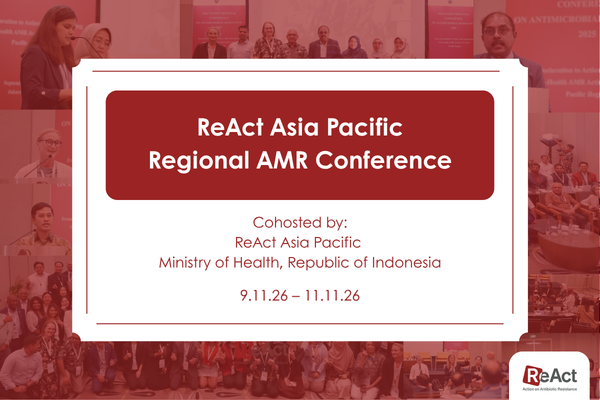
A diverse group of governments, regional institutions, development partners, technical experts, academia, civil society, and representatives from health, agriculture, animal health, food systems, and environment sectors will come together in Jakarta for the three-day ReAct Asia Pacific Regional AMR Conference 2026 and High-Level Ministerial Dialogue.
Co-hosted by Ministry of Health, Indonesia
The conference, co-hosted by the Ministry of Health, Indonesia and ReAct Asia Pacific, will be held from 9–11 November 2026. Building on the momentum of two successive Asia-Pacific AMR Conferences convened in Jakarta in 2024 and 2025, this third regional convening seeks to strengthen the connection between implementation experience and political decision-making.
Lessons and stakeholder recommendations
The meeting will provide a structured regional dialogue through which implementation lessons and stakeholder recommendations can inform high-level policy discussions and contribute to ongoing regional and global antimicrobial resistance (AMR) processes.
Conference objectives:
- Review progress, challenges, and lessons learned in implementing AMR commitments following the 2024 United Nations General Assembly High-Level Meeting on AMR.
- Identify practical priorities requiring strengthened political leadership, financing, regional cooperation, and multi-sectoral engagement across governance, surveillance, stewardship, access, innovation, and One Health implementation.
- Provide a structured mechanism through which implementation experiences, technical expertise, stakeholder perspectives, and civil society inputs can inform high-level regional dialogue.
- Strengthen collaboration among governments, regional institutions, development partners, academia, civil society, and technical experts working on AMR across the Asia-Pacific region.
- Develop a coordinated Asia-Pacific perspective to inform ongoing global AMR discussions and future accountability processes.
Strengthen regional alignment
During the conference-days stakeholders from across the Asia-Pacific region will come together to develop evidence-informed recommendations and strengthen regional alignment on AMR.
Through stakeholder consultations, technical discussions, and thematic deliberations, the meeting will generate a Multi-Stakeholder Recommendations Brief to inform the High-Level Ministerial Dialogue, followed by a Jakarta Statement on AMR that builds on the 2025 Jakarta Consensus and reflects shared regional priorities and opportunities for collaboration.
Turn dialogue into measurable impact
With a collective determination to turn dialogue into measurable impact, the Asia-Pacific AMR Conference 2026 will strengthen understanding of common implementation challenges, support a coordinated Asia-Pacific perspective in global AMR discussions and accountability processes, and identify priority areas for continued regional dialogue and cooperation through existing mechanisms leading up to 2029.
Read more
10 key takeaways from the Asia Pacific AMR Conference 2025
From Declaration to Action: Insights from the ReAct Asia Pacific 2025 Conference Report
More from "2026"
- From People to Leaders: Bridging community priorities and global action ahead of Abuja 2026
- Six key takeaways from ReAct Africa Annual AMR Conference 2026
- Beyond diplomatic aspirations: Bridging the implementation gap in Pandemic Preparedness and AMR
- ReAct Asia Pacific Regional AMR Conference 2026 in November!
- Ukrainian Chief Nurse Alla Kuzhel: “Antibiotic resistance is not a problem of the future”
- Launch of book on “Reimagining Resistance: A Journey in Creative Disruption”
- Closing the gap: Highlights from the ReAct side event at the 79th WHA on AMR governance and financing
- New IPC and antibiotic resistance course for 50 nurses from Ukraine!
- “Every life is an inspiration”: Community-led antibiotic resistance awareness in Delhi’s slums
- From People to Leaders: Why communities must shape the future of AMR governance
- Abuja meeting postponed: a moment to close the gaps before ministers reconvene
- From rivers to resistance: Dr Diego Quijano on the environmental dimension of AMR
- International gathering on educational gardens, microbiome and AMR
- Bridging the AMR divide: Reflections from the WHA79 side event on equity, access, and community-led solutions
- ReAct’s 2025 Impact Report: From grassroots action to global policy
- Art and bio-solidarity in response to AMR
- Dr. Sharot leads the first antibiotic-smart primary health care center in Sweden
- Addressing AMR through art, childhoods and One Health
- Over 70 antibiotic-smart facilities in two years!
- Webinar: From People to Leaders: Community voices shaping Abuja 2026
- From dialogue to progress: Strengthening global AMR governance
- Why the IPEA matters now: A Policy Brief for Member States
- Extension diploma in Educational Knapsack for Planetary Health
- From the World Health Assembly to the communities: Why youth must show up for the next Global Action Plan on AMR
- Ndahafa Imene: Turning curiosity into action on AMR
- Uniting Voices for Action: Inside the WHO Civil Society Task Force on AMR
- The Abuja High-Level Ministerial meeting: a chance to renew ambition and improve accountability to make the global response to antibiotic resistance more effective
- ReAct Europe at the 2026 Nobel Prize Teacher Summit: Global health in focus
- Securing the future of health: ReAct Latin America and Idec propose a new regional strategy for the Americas
- World Health Day: Reflecting on the penicillin revolution
- Reimagining AMR action through community voices: Lessons from Jahangirpuri, New Delhi, India
- Share your perspective: Community priorities survey for the Abuja 2026 AMR Ministerial Meeting
- Belén Juca: When the garden becomes a classroom for AMR
- ReAct at first Regional Meeting on AMR in Brasilia
- Faith Based Organizations: Critical allies for stronger action on AMR
- From Declaration to Action: Insights from the ReAct Asia Pacific 2025 Conference Report
- Antibiotic resistance and aquaculture: Why It matters for One Health
- Revised Global Action Plan on AMR delayed over technology transfer language
- Reflections from the EU JAMRAI2 Annual Meeting
- ReAct Latin America at global AMR Summit in Costa Rica
- A regional anthology: 20 years of action on antibiotic resistance
- Mobilizing faith-based organizations to address antibiotic resistance in Africa
- India’s AMR Response: High-level leadership and Implementation challenges
- Protecting cancer care in the age of antibiotic resistance
- BRIDGE-ABR: A ReAct-led collaboration on goal conflicts, antibiotic resistance and sustainability