Release! New ReAct Strategic Plan 2027–2030: Addressing antibiotic resistance in an era of polycrisis
Share the article
2026-10-13
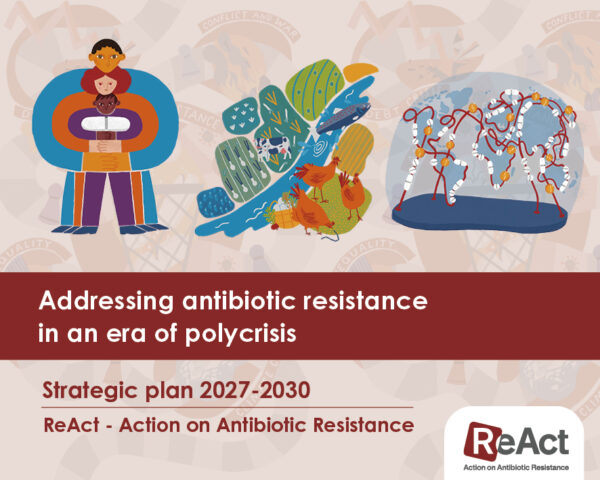
ReAct – Action on Antibiotic Resistance is proud to announce the release of its new strategic plan for 2027–2030, entitled Addressing Antibiotic Resistance in an Era of Polycrisis.
Click image to download ReAct Strategic Plan 2027-2030 as PDF.
This new strategic plan positions ReAct’s work to catalyze and enact sustainable change in the face of an increasingly complex reality, in which the international community is confronted with multiple global crises at once:
The climate crisis
the debt crisis gripping many low- and middle-income countries
rising inequality
the highest number of conflicts and wars since World War II and
antibiotic resistance
are all global challenges unprecedented in urgency, scale and severity, and they are deeply interconnected.
At the same time the world’s capacity to respond to this polycrisis is strained by weakened multilateralism and constrained global financing.
Three broad strategic areas
Against this backdrop, the new strategic plan sets out how ReAct, with its global reach and local presence, will focus its work over the coming four years to catalyze and deliver lasting change to preserve effective antibiotics for generations to come.
The plan identifies three broad strategic areas in which ReAct will focus its efforts:
Access to effective antibiotics, infection prevention and control, and stewardship — both within and beyond the clinical setting.
Reform of global food systems toward sustainability in antibiotic use, ecosystems, and livelihoods.
Strengthened global governance and financing of the response to antibiotic resistance, through increased political will and broad societal engagement.
Achieving change in an era of polycrisis will require not only a reframing of what ReAct will focus on. It also means reviewing how ReAct can leverage its strengths better to affect local and national change and contribute to global collaboration and action.
Prof. Mirfin Mpundu, Director ReAct Africa. Photo: ReAct Africa
“Catalyzing action in an era of polycrisis will require finding novel pathways for change, and the roles of communities and civil society will be more important than ever.
ReAct envisions an even stronger focus on engaging these actors and linking them to policy processes, to ensure that policy is shaped not only by data, modeling, and extrapolations, but increasingly by the on-the-ground realities and lived experiences of the devastating toll antibiotic resistance takes on patients, communities, and societies.”
says Prof. Mirfin Mpundu, Director of ReAct Africa
Arturo Quizhpe, Director of ReAct Latin America. Photo: ReAct Latin America.
“In ReAct Latin America, the connections between antibiotic resistance, the climate crisis, and socio-economic issues such as inequality have always been the nexus of our work with communities, movement building, and policy.
ReAct will continue to build on this experience to advance inclusive whole-of-society approaches to tackling antibiotic resistance.”
says Dr. Arturo Quizpe, Director of ReAct Latin America.
Dr. S.S. Lal, Director ReAct Asia Pacific. Photo: ReAct Asia Pacific.
“Despite its devastating consequences, antibiotic resistance remains a relatively niche issue in the broader landscape of global challenges that define today’s polycrisis.
We must identify where action on antibiotic resistance intersects with and reinforces efforts to address other major global challenges.
By highlighting these synergies, we can build broader support for action and accelerate progress. This approach will also enable ReAct to commit to and invest in new areas, including food system reform.”
says Dr. Lal, Director of ReAct Asia Pacific.
Anna Sjöblom, Director, ReAct Europe. Photo: ReAct Europe
Anna Sjöblom, Director of ReAct Europe, says:
“We are delighted to finally share this strategy, which has been nearly a year in the making across our global network.
We hope it will reach and engage a wider community of actors across the polycrisis spectrum – from health care workers, to actors across the food production chain, and political decision makers – and that it will inspire new and exciting partnerships and collaborations capable of delivering change at scale.”
In-person launch and online webinar
The new strategic plan will be presented and formally launched at an in-person event during the upcoming ReAct Asia-Pacific Regional Conference on AMR, to be held in Jakarta, Indonesia, on November 9–10.
An online launch webinar will also be held in early December 2026. More information will follow shortly.