
2026-11-06
A warm welcome to the ReAct Asia Pacific Conference on Antimicrobial Resistance 2026! The conference is convened by The Ministry of Health, Republic of Indonesia and ReAct Asia Pacific in Jakarta on 9–10 November 2026. Building on regional convenings held in Jakarta in 2024 and 2025, the conference will provide a platform for governments, regional and technical institutions, development partners, implementers, researchers, civil society and communities to review progress, exchange implementation experience and identify shared priorities for accelerating AMR action across the region.
Antimicrobial resistance is a major public health challenge that requires coordinated action across human health, animal health, agriculture, food systems and the environment. Although countries across Asia and the Pacific have made commitments to address AMR, progress varies considerably, reflecting differences in health systems, financing, surveillance capacity and implementation experience.
Bridging Policy, Practice and People to Accelerate Regional Action on AMR
The conference is convened under the theme “Bridging Policy, Practice and People to Accelerate Regional Action on AMR.” The theme recognizes that stronger AMR outcomes require closer alignment between policy commitments, implementation realities, and the needs and experiences of people and communities. By bringing together decision-makers, technical experts, implementers, frontline practitioners and community voices, the conference will create space to examine persistent implementation gaps, share practical experience and strengthen collaboration across countries and sectors.
The two-day conference will produce a Multi-Stakeholder Recommendations Brief bringing together priority actions and areas for national, regional and political consideration. The brief will support continued engagement with ministries, regional institutions, development and technical partners, and other stakeholders, and provide a basis for future high-level dialogue and policy engagement on AMR across the Asia-Pacific.
Conference objectives
- Review progress, challenges and lessons learned in implementing AMR commitments following the 2024 United Nations General Assembly High-Level Meeting on AMR.
- Identify practical priorities for accelerating AMR action, with attention to the enabling conditions needed for effective implementation at national and regional levels.
- Bring together policy, practice and people by creating space for implementation experience, technical expertise, frontline perspectives, civil society and community voices to inform regional AMR priorities.
- Strengthen regional collaboration and shared learning among governments, regional institutions, technical and development partners, academia, implementers and civil society across the Asia-Pacific.
- Articulate shared Asia-Pacific priorities that can support national action, regional cooperation and future high-level policy and accountability processes
Who will participate?
The conference is designed to bring together diverse perspectives from across the Asia-Pacific region and the wider global AMR community.
The conference will convene:
- national AMR focal persons and senior government officials from countries across the WHO South-East Asia, Western Pacific and Eastern Mediterranean Regions
- WHO Regional Offices and Quadripartite organizations
- regional institutions
- development and financing partners
- technical and implementing partners
- researchers and academia
- civil society representatives
- representatives from communities, Youth and people with lived experience of AMR.
Participation includes human health, animal health, agriculture, food systems and the environment, reflecting the multisectoral nature of the AMR response.
The conference provides opportunities to exchange experiences across countries, build cross-sectoral partnerships and identify approaches that can be adapted to different national and local contexts.
Expected conference outcomes
- A Multi-Stakeholder Recommendations Brief setting out a focused set of priority actions for national, regional and political consideration.
- Clearer identification of implementation gaps, enabling conditions and opportunities for regional cooperation across the AMR response.
- Strengthened connections among governments, technical partners, implementers, civil society and other stakeholders to support continued regional collaboration and exchange.
- A practical basis for engagement with ministries, regional institutions and partners, and for future high-level policy and ministerial discussions on AMR in the Asia-Pacific.
Program highlights
The program covers two days of discussions, presentations, poster sessions and collaborative working groups.
Day 1 — Monday, 9 November 2026
The first day will establish the regional context and examine the priorities and practical challenges facing the AMR response.
Key sessions include:
- Opening ceremony, welcome and group photograph.
- ReAct’s strategic direction for addressing antibiotic resistance in an era of polycrisis.
- From global commitments to regional delivery.
- The next phase of the AMR response in Asia and the Pacific.
- Strengthening multisectoral governance and financing.
- Bridging policy and practice to overcome implementation barriers.
- Implementation research: scaling what works in real-world settings.
- Regional Solutions Spotlight I, featuring selected poster presentations.
Day 2 — Tuesday, 10 November 2026
The second day will focus on implementation gaps, equitable access, innovation and priorities for collective action.
Key sessions include:
- Emerging AMR threats and strengthening preparedness and response.
- Equitable access to essential antibiotics and diagnostics.
- Regional Solutions Spotlight II.
- Parallel action groups addressing:
– Antimicrobial stewardship in practice.
– Surveillance, laboratories and data-to-decision across One Health.
– Preventing infections and reducing the need for antimicrobials across One Health.
Action-group report-backs and plenary discussion. - Scientific and technological innovations for AMR.
- Putting people at the centre of the AMR response.
- Agreeing Asia-Pacific priorities through an interactive prioritisation exercise.
Please consult the final agenda for confirmed session timings, speakers, room assignments and any programme changes.
Download detailed program (PDF)
Poster presentation
In a public call, the conference organizers received 97 abstracts for posters from 27 countries. Of these 12 posters are selected to be a part of the conference, with a considerable share of presenters being early-career professionals.
Additionally, ReAct invited posters from 3 youth organisations (Superheroes Against Superbugs, International Pharmaceutical Students’ Federation, and NYMAT Global) who are a part of the Asia-Pacific Youth AMR Task Force.
ReAct presents two posters: One by ReAct Asia Pacific and one about the new ReAct Strategic Plan 2027-2030.
Release ReAct Strategic Plan 2027-2030
Release of the new ReAct Strategic Plan 2027-2030
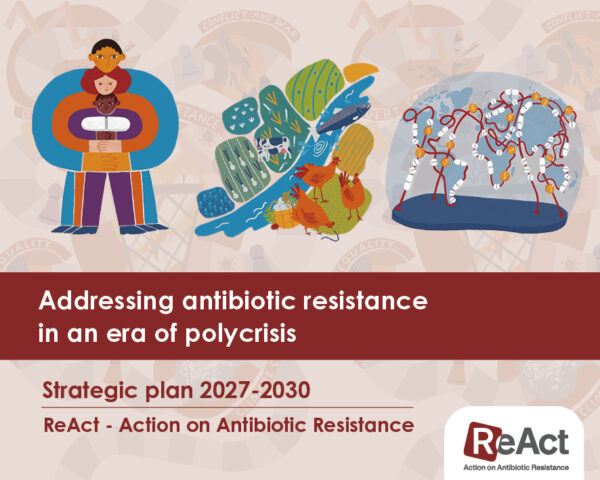
ReAct – Action on Antibiotic Resistance is proud to announce the release of its new strategic plan for 2027–2030, entitled “Addressing antibiotic resistance in an era of polycrisis”. This new strategic plan positions ReAct’s work to catalyze and enact sustainable change in the face of an increasingly complex reality, in which the international community is confronted with multiple global crises at once
Civil Society workshop on AMR in Indonesia
Ahead of the Asia Pacific Regional Conference on Antimicrobial Resistance, ReAct Asia Pacific, with support from Yayasan Orang Tua Peduli, convene a closed-door workshop for Indonesian civil society organisations in Jakarta on 7 November 2026. Participants will explore how their work in areas such as clean water and sanitation, food safety and animal welfare already helps prevent antimicrobial resistance (AMR). Through a One Health approach, they will identify practical ways to build on these efforts and bring community experience into Indonesia’s response to AMR.
High-Level Ministerial Dialogue on the future of AMR in Asia-Pacific
Following the Asia Pacific Regional Conference on AMR, the Ministry of Health of the Republic of Indonesia and ReAct Asia Pacific will co-host a closed-door High-Level Ministerial Dialogue in Jakarta on 11 November 2026. Ministers of Health, heads of delegation and leaders of regional and international institutions will draw on the conference recommendations to identify where countries can work together on antimicrobial resistance (AMR). The dialogue aims to agree on shared regional priorities for the Jakarta Statement on AMR ahead of the 2029 United Nations review.
More from "2026"
- From fighting bacteria to dancing with life
- New ReAct Strategic Plan 2027–2030: Addressing antibiotic resistance in an era of polycrisis
- Abuja Compact: 4 key areas to carry commitments forward
- Maarifa Kids Zambia: Children as key AMR stakeholders
- ReAct Europe at Ukraine ReHealth 2026: Building resilient healthcare in times of war
- From people to leaders: strengthening community voices in the AMR response
- A detective story: Who killed the rational use of medicine?
- From People to Leaders: Bridging community priorities and global action ahead of Abuja 2026
- Six key takeaways from ReAct Africa Annual AMR Conference 2026
- Beyond diplomatic aspirations: Bridging the implementation gap in Pandemic Preparedness and AMR
- Connecting environment, AMR and youth action: meet Sarah Rauzana
- Welcome to the ReAct Asia Pacific Conference on Antimicrobial Resistance 2026!
- ReAct Asia Pacific Regional AMR Conference 2026 in November!
- Ukrainian Chief Nurse Alla Kuzhel: “Antibiotic resistance is not a problem of the future”
- Launch of book on “Reimagining Resistance: A Journey in Creative Disruption”
- Closing the gap: Highlights from the ReAct side event at the 79th WHA on AMR governance and financing
- New IPC and antibiotic resistance course for 50 nurses from Ukraine!
- “Every life is an inspiration”: Community-led antibiotic resistance awareness in Delhi’s slums
- From People to Leaders: Why communities must shape the future of AMR governance
- Abuja meeting postponed: a moment to close the gaps before ministers reconvene
- From rivers to resistance: Dr Diego Quijano on the environmental dimension of AMR
- International gathering on educational gardens, microbiome and AMR
- Bridging the AMR divide: Reflections from the WHA79 side event on equity, access, and community-led solutions
- ReAct’s 2025 Impact Report: From grassroots action to global policy
- Art and bio-solidarity in response to AMR
- Dr. Sharot leads the first antibiotic-smart primary health care center in Sweden
- Addressing AMR through art, childhoods and One Health
- Over 70 antibiotic-smart facilities in two years!
- Webinar and survey: From People to Leaders: Community voices shaping Abuja 2026
- From dialogue to progress: Strengthening global AMR governance
- Why the IPEA matters now: A Policy Brief for Member States
- Extension diploma in Educational Knapsack for Planetary Health
- From the World Health Assembly to the communities: Why youth must show up for the next Global Action Plan on AMR
- Ndahafa Imene: Turning curiosity into action on AMR
- Uniting Voices for Action: Inside the WHO Civil Society Task Force on AMR
- The Abuja High-Level Ministerial meeting: a chance to renew ambition and improve accountability to make the global response to antibiotic resistance more effective
- ReAct Europe at the 2026 Nobel Prize Teacher Summit: Global health in focus
- Securing the future of health: ReAct Latin America and Idec propose a new regional strategy for the Americas
- World Health Day: Reflecting on the penicillin revolution
- Reimagining AMR action through community voices: Lessons from Jahangirpuri, New Delhi, India
- Share your perspective: Community priorities survey for the Abuja 2026 AMR Ministerial Meeting
- Belén Juca: When the garden becomes a classroom for AMR
- ReAct at first Regional Meeting on AMR in Brasilia
- Faith Based Organizations: Critical allies for stronger action on AMR
- From Declaration to Action: Insights from the ReAct Asia Pacific 2025 Conference Report
- Antibiotic resistance and aquaculture: Why It matters for One Health
- Revised Global Action Plan on AMR delayed over technology transfer language
- Reflections from the EU JAMRAI2 Annual Meeting
- ReAct Latin America at global AMR Summit in Costa Rica
- A regional anthology: 20 years of action on antibiotic resistance
- Mobilizing faith-based organizations to address antibiotic resistance in Africa
- India’s AMR Response: High-level leadership and Implementation challenges
- Protecting cancer care in the age of antibiotic resistance
- BRIDGE-ABR: A ReAct-led collaboration on goal conflicts, antibiotic resistance and sustainability